Design-Build vs Traditional Construction: Which Is Better for Industrial Projects?...
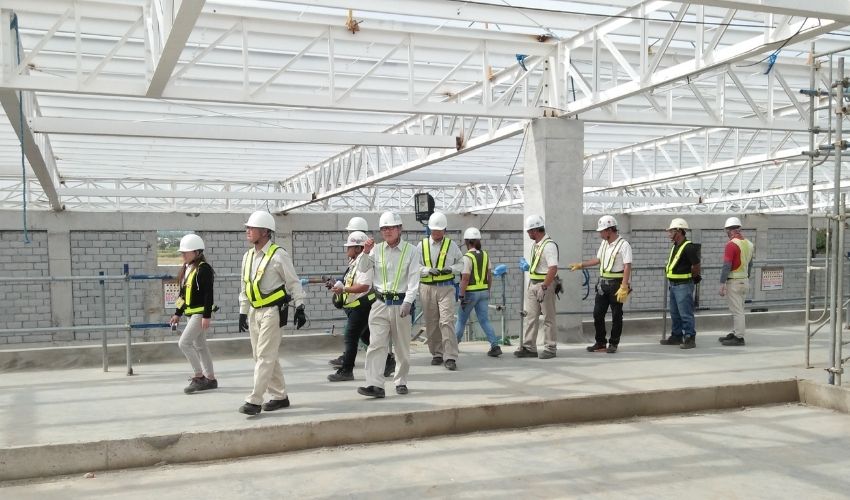
Companies responsible for building factories not only worry about walls, they also worry about continuity. Continuity of production, continuity of equipment alignment, continuity of workforce safety and continuity of operations after unexpected events.
Industrial structural engineering determines whether a facility protects those priorities or quietly undermines them.
Most organizations entering the Philippines focus first on location, utilities, and permitting timelines. Structural engineering decisions often appear technical, even secondary.
In reality, structural strategy defines how efficiently a facility operates for decades.
Factories succeed when structure supports production, and they struggle when structure merely encloses it.
Office towers support people.
Factories support motion.
Heavy equipment introduces vibration behavior that changes slab performance. Rack storage systems introduce vertical load concentrations that evolve over time. Conveyor infrastructure redistributes dynamic stresses across structural
frames. Temperature variation inside production halls affects expansion movement. Industrial structural engineering anticipates these forces before they appear.
Without that anticipation, efficiency losses emerge gradually and quietly.
Machines require recalibration more often. Storage systems lose alignment faster. Maintenance schedules shorten. Expansion flexibility disappears.
Facilities engineered correctly avoid those problems before operations begin.
Production equipment typically costs more than the building surrounding it, such as:
All these depend on structural stability.
Even minor slab movement affects calibration tolerance. A slight vibration amplification affects robotic consistency. Differential settlement affects conveyor alignment.
Industrial structural engineering ensures equipment operates as designed instead of adapting to structural compromise.
Executives evaluating facility construction often underestimate this relationship until performance variability begins affecting production reliability.
By then, structural corrections become expensive.
Early engineering decisions prevent those costs entirely.
The Philippines sits inside an active seismic region.
Factories designed without seismic strategy may pass inspection. They may even perform well under normal conditions. But resilience is not measured during calm conditions.
It is measured during stress events.
Facilities engineered with Seismic Resistant structural systems protect more than occupants. They protect production continuity, asset alignment, and inventory integrity.
Seismic strategy influences:
foundation detailing steel frame flexibility bracing systems connection strength
equipment anchoring integration
These elements determine whether a facility resumes operation quickly after an event or pauses production indefinitely. Executives planning long-term industrial presence recognize this difference immediately.
Production efficiency rarely depends on machinery alone.
It depends on how the structure supports machinery placement.
Column spacing affects line configuration flexibility. Roof height influences equipment clearance planning. Load-bearing strategy affects mezzanine integration possibilities. Floor capacity determines storage density potential.
Industrial structural engineering creates options before equipment selection finalizes. Facilities designed with flexibility support future expansion without reconstruction.
Facilities designed without flexibility restrict growth before operations even begin.
This distinction affects investment strategy more than most organizations expect during early planning stages.
Structural design does not succeed in isolation.
It succeeds when coordinated with architectural, mechanical, and utility infrastructure planning. Industrial facilities demand alignment between:
equipment foundations utility trenches
process piping
floor flatness tolerances overhead crane systems expansion zones
Coordination errors inside these interfaces rarely appear immediately. They appear during commissioning.
When structural engineering integrates with full construction planning early, those conflicts disappear before they reach site execution.
This coordination discipline reflects Japanese Quality methodology, where planning accuracy protects construction reliability rather than correcting mistakes afterward.
Structural drawings alone do not guarantee structural performance.
Execution accuracy determines whether engineering intent becomes operational reality. Disciplined construction QA QC in the Philippines frameworks verify:
reinforcement placement precision concrete strength performance steel connection integrity foundation alignment tolerance
load-bearing compliance
Inspection systems protect long-term structural reliability by identifying deviations before they become permanent.
Industrial facilities built under structured QA frameworks maintain dimensional accuracy that supports equipment installation success later.
Executives rarely see these processes directly. They experience their impact through smoother commissioning.
Industrial expansion often involves multiple facilities over time.
Organizations building second or third production sites benefit from consistent engineering frameworks.
Facilities executed under ISO construction standards in the Philippine Methodology maintain predictable documentation accuracy and structural consistency across locations.
This consistency reduces engineering adaptation time between expansion phases. It also simplifies maintenance planning across multiple facilities.
Executives managing regional manufacturing networks value predictability more than novelty. ISO-aligned structural engineering delivers that predictability.
Inspection frameworks often appear administrative from outside the construction process. Inside industrial construction, they serve a different purpose.
They protect alignment between engineering assumptions and field execution. A disciplined construction inspection process in the Philippines verifies:
Without inspection discipline, minor deviations accumulate into operational inefficiencies. With inspection discipline, facilities perform exactly as designed.
Companies experience this as smoother commissioning timelines.
Speed and precision rarely coexist unless engineering supports both simultaneously.
Industrial projects delivered under coordinated structural planning achieve Fast Turnaround timelines because sequencing decisions occur early.
Steel fabrication begins sooner. Foundation preparation aligns with equipment delivery planning. Structural installation proceeds without redesign interruptions.
Speed achieved through planning differs from speed achieved through compression. One protects quality.
The other risks it.
Executives evaluating industrial construction schedules should recognize this difference immediately.
Industrial construction schedules rarely slip because teams lack effort. They slip because structural coordination problems appear late.
Late foundation adjustments late steel redesign
late equipment interface corrections late slab tolerance conflicts
Integrated structural engineering prevents these disruptions before site work begins.
Facilities delivered under disciplined engineering frameworks consistently achieve On-Time Completion performance because execution uncertainty disappears earlier in the schedule.
Executives planning production launch windows depend on this certainty.
Factories rarely fail suddenly.
They decline gradually when structure restricts adaptation.
Future production upgrades require stronger slabs. Automation upgrades require different column spacing tolerances. Expansion phases require connection-ready framing systems.
Facilities engineered with foresight support evolution. Facilities engineered only for immediate use resist it.
Industrial structural engineering defines which category a facility belongs to.
Organizations planning long-term operations across Southeast Asia increasingly recognize that engineering decisions made during construction influence operational flexibility decades later.
And that recognition shapes contractor selection long before construction begins.
Structural engineering decisions made today shape how efficiently a factory operates for decades. Facilities delivered by CCT Constructors Corporation are engineered to support equipment stability, workforce safety, and long-term operational flexibility from the beginning. Through Japanese Quality execution standards, Seismic Resistant engineering, disciplined inspection systems, and Fast Turnaround schedules that protect commissioning timelines, CCT helps ensure production environments perform exactly as intended. For organizations planning facilities where structural precision directly affects output reliability, working with a contractor that prioritizes On-Time Completion certainty and engineering integrity makes the difference between a building that functions and one that performs.
Design-Build vs Traditional Construction: Which Is Better for Industrial Projects?...
How Industrial Structural Engineering Improves Factory Safety and Efficiency Companies...
PEZA Building Requirements for Foreign Investors Foreign investors rarely enter...



© 2026 CCT Constructors Corporation | Privacy Policy | Terms of Service